


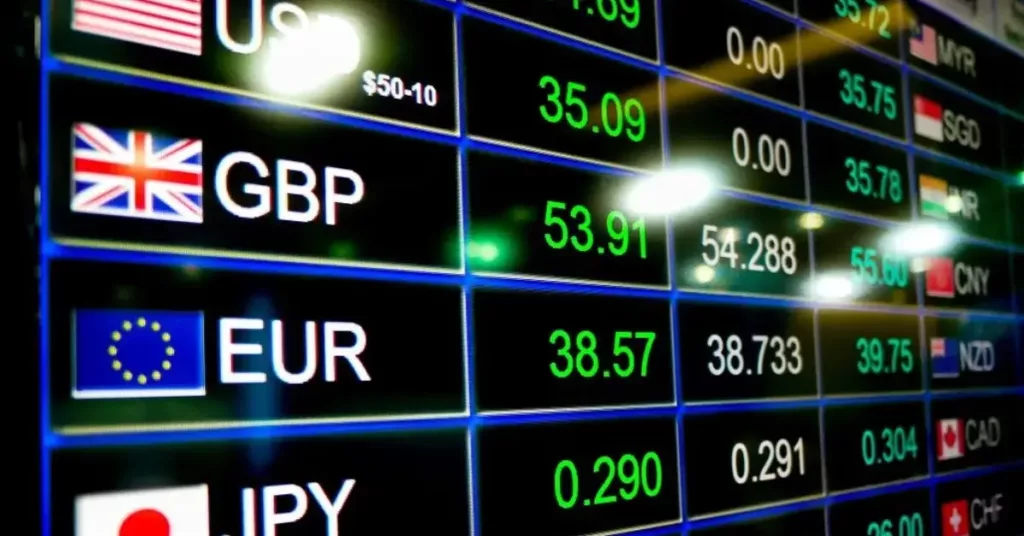
We hear the term “exchange rate” all the time, especially when we’re planning a trip abroad or thinking about buying something from an overseas website. But what does it really mean?
In short, an exchange rate is simply the value of one currency compared to another.
Putting it another way, it’s the price you have to pay in one currency to get one unit of another. For instance, if the EUR/USD exchange rate is 1.10, it just means you need €1 to buy $1.10. As you can imagine, this number is crucial, and not just for tourists, it’s a cornerstone of all international trade.
How Are Exchange Rates Determined?
First, it’s helpful to know that most major currencies (like the Euro, Dollar, or Yen) are “floating.” This means their value isn’t just arbitrarily set by a government.
In reality, the rate is mostly set by supply and demand on a massive global market: the Forex (Foreign Exchange Market). So, if a currency is suddenly in high demand (maybe because its country’s economy is seen as very strong), its value will go up compared to others. On the flip side, if confidence in an economy is lost, investors will sell off that currency, and its value will drop.
Why Do Exchange Rates Fluctuate Constantly?
You’ve probably noticed this: the rate you see yesterday is almost never the same today. This constant movement is influenced by a whole mix of complex factors.
On one hand, a country’s overall economic health is under a microscope: inflation levels, growth figures (GDP), and unemployment rates are all key indicators. On the other hand, decisions made by central banks (like the ECB in Europe or the Fed in the U.S.) have a huge impact. When a central bank raises its interest rates, that currency becomes more attractive to savers, which often strengthens its value.
Plus, political stability shouldn’t be underestimated. An uncertain political situation in a country can lead to capital flight, which is why the local currency will weaken.
The Catch You Need to Know: Real Exchange Exchange Rate vs. Commercial Rate
This is a really important distinction to make, as it directly impacts your wallet. The exchange rate you often see on the news or on Google (often called the “interbank rate” or “real rate”) is never the rate you’ll actually be offered by your bank or a currency exchange office.
Why is that? Because those intermediaries logically need to get paid for the service they provide. As a result, a “margin” or “commission” is always applied to that base rate. The “commercial” rate you’re finally offered will always be a bit less favorable for you. That’s why it’s crucial to look not just at the rate, but at the extra fees before you make a transaction.
Where Can You Find the Best Rates?
This brings up the next logical question: where should you go to exchange your money? Traditionally, banks and physical exchange bureaus (at airports or in town) were the only options.
With digitization, though, many alternatives are now preferred. Online money transfer platforms and “neobanks” (mobile banks) are often known for being more competitive. Because their cost structures are generally lighter, they can often propose rates that are closer to the real rate for their customers. Still, you have to be careful: a comparison of the total fees (rate + fixed commission) should always be done before you commit to the operation.
To conclude, the exchange rate is much more than just a number; it’s the vibrant pulse of world economies. Whether you’re getting ready for a vacation or managing an international business, having a good grasp of how it works has become essential. Now you not only know how this rate is set, but also why it’s smart to compare the commercial offers you’re given!
Try Transfergratis today and optimize your international financial flows! The Transfergratis platform is a free, fast, and secure money transfer service from Canada to Africa. Download the app on the Play Store or the App Store.