


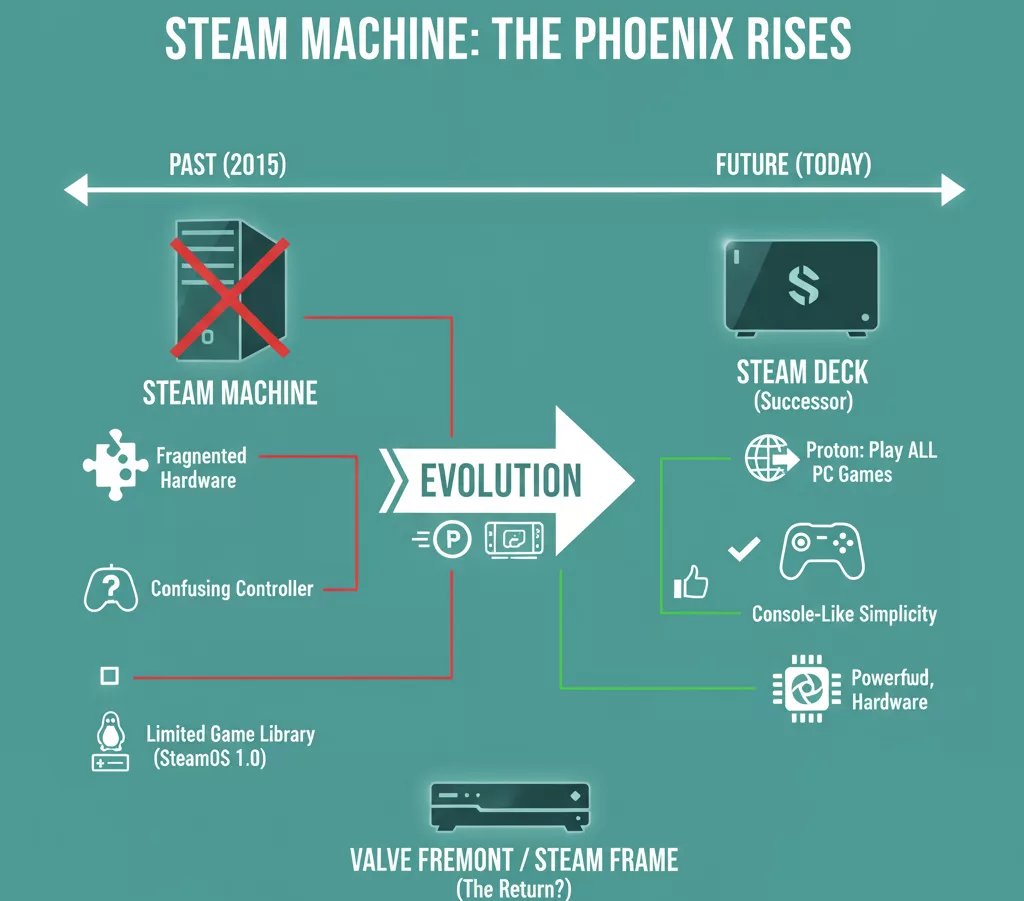
Ten years ago, Valve, the giant behind the Steam platform, attempted a revolution: bringing the power of PC gaming into the living room with the simplicity of a console. The project was called the Steam Machine. The idea was ambitious, but the launch in 2015 resulted in a crushing commercial failure.
However, the story doesn’t end there. Today, the Steam Machine is just a memory for many. Nevertheless, the technological legacy of this aborted project is resurrecting in a new form, more powerful and more relevant than ever.
The Initial Failure: A Missed Opportunity
Several factors led to the project’s premature demise in 2018:
- The Software Problem (SteamOS 1.0): At the time, Valve required developers to directly port their games to Linux. Consequently, the catalogue of available games was too limited compared to Windows.
- Fragmented Hardware: Steam Machines were produced by various manufacturers (Alienware, etc.). This approach led to high costs, inconsistent performance, and created confusion among consumers.
- The Controversial Steam Controller: The controller, with its unique trackpads, was innovative, but too difficult for the typical console player to master.
In summary, the concept of an open PC in the living room was too far ahead of its time and lacked the necessary simplicity to compete with the PS4 and Xbox One.
The Revolutionary Legacy: Valve’s Masterstroke
Despite this commercial setback, the Steam Machine laid fundamental technological groundwork for Valve’s future.
-
SteamOS and Proton: The Linux Miracle
This is where the true revolution lies. Valve never abandoned the idea of freeing gamers from Windows.
- The Steam Deck (The True Successor): The portable console adopted the Steam Machine’s operating system, SteamOS, but coupled it with Proton, an incredible compatibility layer.
- The Result: Proton now allows PC games designed for Windows to run on Linux without modification by developers. Thus, almost the entire massive Steam library is now playable on SteamOS.
-
The Simplification of the Console Experience
The Steam Deck demonstrated that the user experience, with its simple, controller-optimised interface, can compete with traditional consoles. It succeeded where the first Steam Machines had failed: offering the simplicity of a console with the freedom of a PC.
The Future: An Inevitable Return to the Living Room?
Today, rumours and leaks (notably concerning the Valve Fremont or Steam Frame project) indicate that Valve is preparing its return to the living room market. Building on the Steam Deck experience, Valve no longer faces the same constraints:
- The Software Problem is Solved: The SteamOS + Proton ecosystem is mature and ready for the mainstream.
- Hardware Control: Valve seems intent this time on controlling the entire machine (as with the Steam Deck), thus guaranteeing uniform performance and ergonomics.
- The Goal: To offer a SteamOS living room console, more powerful than a Steam Deck, and capable of directly competing with the PS5 and Xbox Series.
Therefore, the original Steam Machine was not a viable product, but it was a beta version. The true potential, which was to place the Steam ecosystem at the heart of the living room without depending on Microsoft, is about to be finally realised.
Try Transfergratis today and optimize your international financial flows! The Transfergratis platform is a free, fast, and secure money transfer service from Canada to Africa. Download the app on the Play Store or the App Store.