
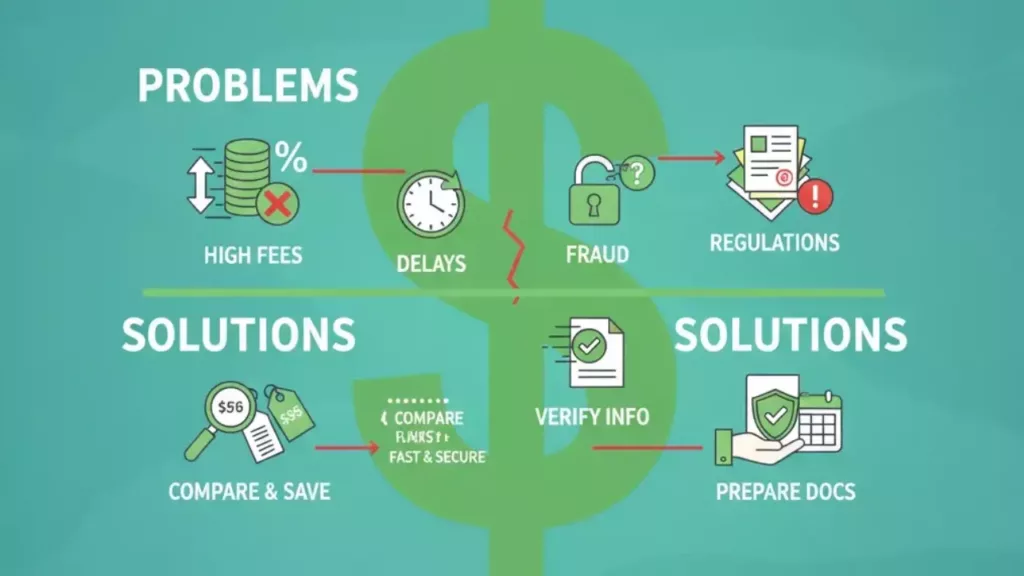
Money transfers, which means sending money from one place to another, especially internationally, are very important. They allow families and friends to support each other. However, they can also cause problems. It is essential to know about them so you can avoid them!
1. High Costs and Hidden Fees
The most frequent problem is the cost.
- On the one hand, banks and money transfer companies often charge high sending fees. These fees reduce the amount the recipient receives.
- On the other hand, there is the problem of the exchange rate. Many intermediaries apply an exchange rate that is less favorable than the real market rate. This difference is another form of hidden fee.
In short, these costs can represent a large portion of the money you send, especially to regions like Sub-Saharan Africa where fees remain among the most expensive.
2. Delays and Slow Transactions
Furthermore, transfers are not always fast.
- For example, an international bank transfer can take several business days. This delay is sometimes difficult when the money is needed urgently.
- Also, if the recipient’s bank details are incorrect (IBAN, SWIFT/BIC), the transaction is blocked, and this creates an additional delay.
3. Risks of Errors and Fraud
Next, there is the risk of human error or fraud.
- A simple typo in the beneficiary’s name or account numbers can lead to the blocking of the transfer.
- Similarly, scams, such as phishing (fake emails asking for bank information), can lead to the loss of money.
4. Non-Compliance with Regulations
Finally, for large amounts, banks and transfer services must comply with anti-money laundering laws.
- Consequently, they may request supporting documents regarding the origin of the funds or the identity of the beneficiary. If you cannot provide them, the transaction will be blocked.
How to Avoid Problems When Transferring Money: Practical Solutions
To avoid these difficulties, here are a few simple and effective tips:
-
Reducing Costs
- Compare services: Do not automatically use your bank. On the contrary, look at the offers from online transfer platforms (Transfergratis, etc.). Generally, they have lower fees and fairer exchange rates.
- Check the exchange rate: Before sending, use an online comparator. Choose the service that offers the rate closest to the mid-market rate.
- Prioritize the SEPA transfer: If you are in the Eurozone (SEPA), use the SEPA transfer. Indeed, it is often free or very inexpensive.
-
Ensuring Speed and Security
- Double-check the information: This is the golden rule. Make sure the IBAN, the BIC/SWIFT code, and the beneficiary’s full name are perfectly correct before validating.
- Respect limits: Check with your bank or the transfer service the maximum amount you can send per day. This way, you will avoid a blockage.
- Secure yourself against fraud: Never click on suspicious links. Moreover, if someone asks you for an urgent transfer, contact this person through another means (phone) to confirm the request.
-
Anticipating Documentation
- Be prepared for large amounts: If you are transferring a large sum, have the documents that prove the origin of the money on hand (pay slip, deed of sale, etc.). In this way, you will avoid the institution blocking the transfer.
Try Transfergratis today and optimize your international financial flows! The Transfergratis platform is a free, fast, and secure money transfer service from Canada to Africa. Download the app on the Play Store or the App Store.
Create a free account to read this article
Join thousands of members who get exclusive access to expert guides, immigration tips, and the latest TransferGratis news.

