


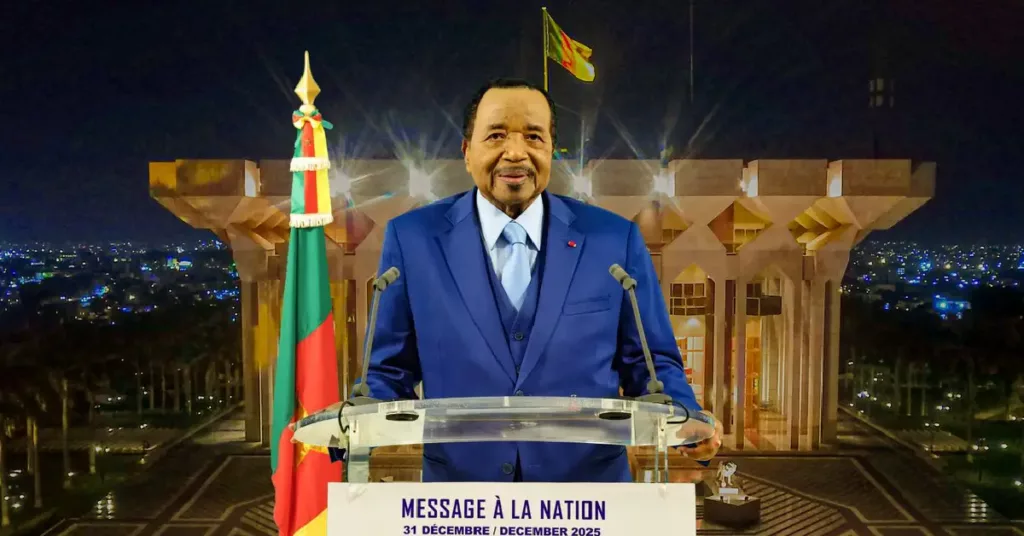
From the banks of the Sanaga River to the northern hills, a new political scenario is unfolding, brimming with promise and suspense, even as the name of the future president remains undisclosed. The story will truly begin to reveal itself on the night of October 12, 2025, when the ballots are counted and the victor’s identity finally emerges from the shadows.
Before knowing who will inherit the presidential seat, one must first meet the players in this electoral joust. Twelve political figures, each carrying a hope, an ideological platform, and a bold vision for the future, are officially in the running. Here is what we know about them, without prejudging the outcome:
1. The Candidate of the Outgoing Majority Paul Biya: This candidate embodies the continuity of the dominant party, which has been in power for decades. He represents the institutional pillar, the enduring strength of a firmly established power, and invokes stability as his central campaign argument.
2. A Former High-Ranking Official Turned Reformer Issa Tchiroma: A figure who long navigated the corridors of power, he has chosen to leave official circles to embody an alternative “from within.” He runs under the banner of a dissident or minor party, drawing on his experience within the system while promising reforms.
3. The Spokesperson for the Unified Opposition Bello Bouba: Several opposition parties have attempted to rally behind this individual to maximize the chances of breaking the dominant party’s monopoly. He embodies the idea of a renewed front and a collective awakening.
4. The Voice of Youth Elected around forty or slightly younger, this candidate bets on generational renewal. They propose a highly digitized platform, focused on technology, youth employment, and a break from certain inherited models of the past. For example, Cabral Libii, at 45, is one of the youngest contenders and has already called for electoral vigilance.
5. The Female Mayor-Turned-National Candidate As the president of a local party, a former mayor, or a territorial official, she embodies a dual break: a gender breakthrough in the presidential arena and a national projection of local roots. Hermine Patricia Tomaïno Ndam Njoya, for instance, of the Cameroon Democratic Union (UDC), has filed her candidacy as a figure representing this type of political action.
6. The Historical Opposition Figure Originating from the previously dominant opposition party, this candidate is attempting a path of renewal or controlled revolution.
7. The Longtime Activist Akéré Muna: A stalwart of the long-standing opposition, this individual has participated in several elections, mobilized support for human rights and good governance, and relies on a party of ideals. He may be less visible in the media but holds a capital of credibility in neighborhoods, associations, and civil society.
8. The Technocrat Without a long electoral political past, this candidate highlights their expertise (economic, financial, administrative) and proposes a “pragmatic” alternative. They state they will be neither left nor right, but driven by efficiency.
9. The Regionalist Hailing from a peripheral region of the country, this candidate advocates for a program of reinforced decentralization, territorial justice, or a rebalancing of national resources towards less favored provinces.
10. The Voice of the Rural Environment or the Agro-Pastoral Sector Their discourse specifically addresses rural areas, farmers, and herders: land security, access to water, and support for small farms. They embody the “voice of the soil.”
11. The Representative of a Small Emerging Party Hiram Iyodi: This candidate leads one of the more recent parties, often without elected officials in parliament, but highly visible in certain specific circles (youth, diaspora, digital platforms). He capitalizes on the desire for novelty.
12. The Candidate Supported by a Cross-Party Movement Neither entirely opposition nor fully allied, this profile tries to capture voters disillusioned with both major camps. They may be supported by local coalitions, citizen associations, or temporary alliances.
The Quiet Stake: Connecting Voters and the Diaspora
What makes this election more symbolic than ever is the importance of the diaspora in the national political process. Every vote counts, whether it comes from a voter in the village or a Cameroonian living abroad, investing efforts to stay connected, send support to family, or simply follow the debates in their homeland.
This is where a service like TransferGratis enters the narrative, not as a political actor, but as a practical link between these worlds. When a diaspora member wishes to contribute to a candidate’s campaign, support a local citizen association, finance the distribution of flyers, or participate in grassroots initiatives, they need to be able to transfer funds quickly, securely, and transparently. TransferGratis offers free money transfers to Africa, with no hidden fees, ensuring that every donation, even a modest one, fully reaches its destination.
Thus, in this campaign where every move on the ground can shift a seat, every franc sent from abroad is potential political fuel. The connection between the voter sitting in Yaoundé and the one residing in Montreal or Douala can be maintained at zero cost through a simple digital transaction. This gives the diaspora a tangible place in the election, beyond debates and speeches.
Suspense Until the Last Ballot
This morning, the country awoke in the same suspense as yesterday. No name has yet been proclaimed, no flag definitively raised. The majority candidate, the dissident, the young hope, or the technocrat all remain in the running. While awaiting the results, discussions are buzzing, alliances are conjectured, and strategies are being developed.
But in the end, the verdict belongs to the ballot boxes on October 12, 2025. It is this date, and this date alone, that will bring the unique name of the president out of the shadows. Among the twelve faces in the running, one will become the embodiment of the national choice. Until then, we must humbly wait.
Try Transfergratis today and optimize your international financial flows! The Transfergratis platform is a free, fast, and secure money transfer service from Canada to Africa. Download the app on the Play Store or the App Store.