


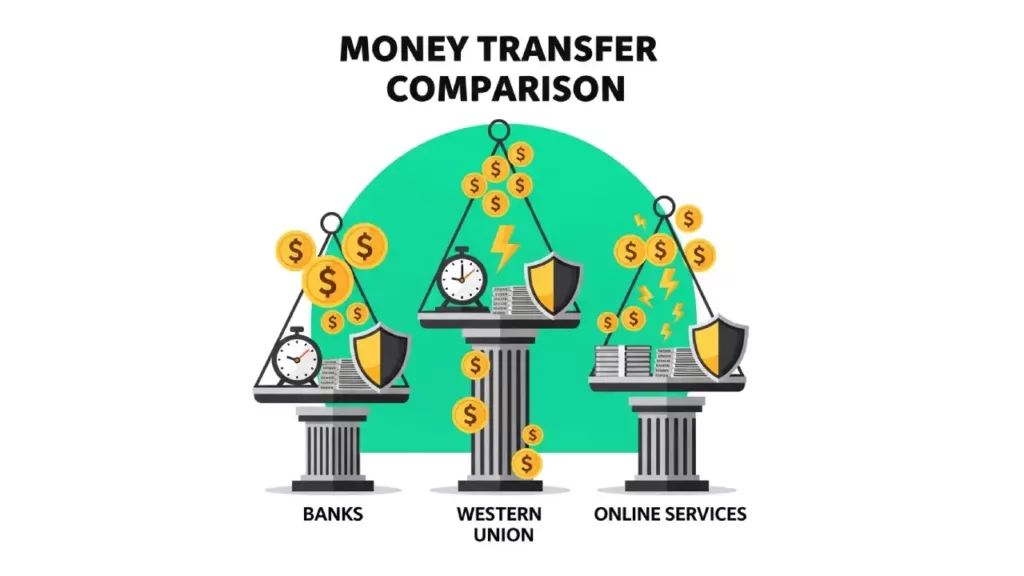
Transfer money internationally or even domestically has become a daily necessity for diaspora communities, businesses, and individuals. However, the choice of platform can have a major impact on the final cost, speed, and security of the transaction.
Who dominates the market? The traditional giant (the Bank), the historical network (Western Union), or the digital challenger (Online Services / FinTechs)? This comparison breaks down the strengths and weaknesses of each method.
1. Traditional Banks: The Guarantee of Security
Banks remain the default method for many transfers, especially those involving large sums or B2B transactions.
Advantages
- Unmatched Security: Strict regulation and historical trust, ideal for large amounts.
- Convenience: Transfers are managed directly through an existing bank account (in-branch or online).
- Beneficiary Accessibility: The recipient receives the funds directly into their bank account.
Disadvantages
- High Fees: International wire transfer (SWIFT or other) fees are often fixed and are compounded by conversion charges.
- Uncompetitive Exchange Rates: The margins applied to exchange rates are generally the least favorable.
- Slowness: Processing times can range from 2 to 5 business days, due to intermediaries (correspondent banks).
2. Western Union & Money Gram: The Global Network
These services are the champions of cash transfers. They are vital in areas where access to banking services or the internet is limited.
Advantages
- Maximum Accessibility: Thousands of physical agent locations in nearly every country, including remote villages.
- Cash Payout: The beneficiary can withdraw the money immediately in cash, without needing a bank account or mobile phone.
- Withdrawal Speed: Funds are often available for collection within minutes after the sender initiates the transfer.
Disadvantages
- Highest Cost: The combination of fixed fees and exchange rate margins often results in the highest total cost on the market, especially for smaller amounts.
- Transfer Limits: Transaction caps may be imposed, particularly for cash transfers.
- Fraud Risks: Although the platforms are secure, cash withdrawal scams (transfer code fraud) are common.
3. Online Services (FinTechs): Digital Efficiency
Platforms like Transfergratis, Wise (formerly TransferWise), or Remitly have revolutionized the sector by optimizing the process through digital networks.
Advantages
- Lowest Fees: Their digital structure and local networks allow them to charge significantly lower fees.
- Favorable Exchange Rates: They often use or come very close to the mid-market exchange rate (interbank rate), ensuring better value for the currency sent (e.g., CAD).
- Speed: Transfers can be instantaneous (to Mobile Money) or very fast (a few hours to a bank account).
- Transparency: Fees and the exact exchange rate are clearly displayed before confirmation.
Disadvantages
- Digital Dependency: Requires internet access, a smartphone, or a computer for the sender, and often a bank account or Mobile Money service for the recipient.
- Geographical Limits: While their coverage is vast, it may be less universal than Western Union’s in very rural areas.
- Public Trust: Although security is very high (encryption and regulation), it has not yet achieved the historical trust status of major banks for the general public.
Summary Comparison
The following table summarizes the performance of the three methods based on the main criteria:
| Criterion | Traditional Bank | Western Union / Money Gram | Online Services (FinTechs) |
| Total Cost (Fees + Rate) | (Most expensive) | (Very expensive) | (Most economical) |
| Transfer Speed | (Slow: 2-5 days) | (Instant for cash pickup) | (Fast: instant to 1 day) |
| Accessibility (Rural) | Low (requires branch/ATM access) | Extremely High (Cash pickup locations everywhere) | Good (if Mobile Money is available) |
| Payment Method | Bank account | Cash, Card, or Account | Card, Bank Transfer |
| Ideal for… | Large amounts, B2B, Formal transactions | Urgency, Recipients without a bank account | Diaspora, Recurring transfers, Savings |
Verdict: Which Service Should You Choose?
The choice of service depends entirely on your specific needs:
- Priority on Economy (Best Exchange Rate): Choose Online Services (FinTechs). They will ensure the largest portion of your funds reaches the destination.
- Priority on Simplicity and Cash Pickup: Choose Western Union / Money Gram, especially if the beneficiary is in a remote area. Be prepared to pay more.
- Priority on Security and Large Transfers: Stick with your Bank, but be aware of the high costs and longer delays.
The evolution of the sector clearly favors digital services, which continue to offer the best value proposition in terms of speed and savings.
Try Transfergratis today and optimize your international financial flows! The Transfergratis platform is a free, fast, and secure money transfer service from Canada to Africa. Download the app on the Play Store or the App Store.